Comicory
Cyberpunk Comic Generator
Neon. Chrome. Rain-slick streets.
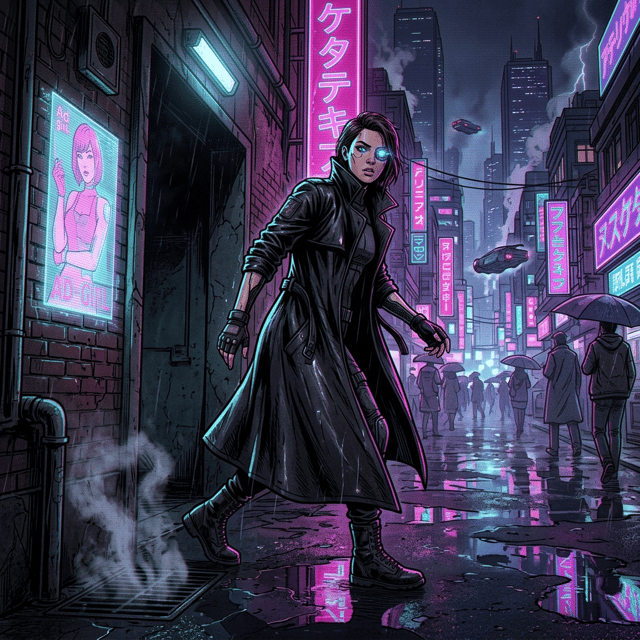
An AI cyberpunk comic generator that drops your characters into a neon megacity at night — holographic billboards, chrome augmentations, dystopian glow, the same cast in every panel.
- Same cast in every panel
How it works
What each step costs.
- 1
Write your story
A paragraph or a whole chapter. Pick a style and a length.
Free - 2
Review the script
The AI splits it into panels with dialogue. Change anything before a single image is drawn.
4 credits - 3
Render the comic
Each character, scene and panel is drawn once, then kept on-model.
1 credit each
Free vs paid
What changes when you pay.
 Made with Comicory · comicory.com
Free
- 10 credits, once, no card
- Downloads carry a small Comicory badge
- 10 of 24 art styles
- Upload 1 character, 1 location & 1 prop of your own
- 1 AI-generated reusable character (1 credit to draw)
Paid
- Clean downloads for a year with any pack, or while a plan is active
- 23 art styles with any subscription, all 24 on Pro and up
- More upload slots (subscriptions, and packs from $19.99)
A cyberpunk comic generator is AI tuned for the look of neon-future sci-fi — rain-slicked alleys, magenta-and-blue lighting, holographic ads, cybernetic implants.
Comicory's cyberpunk style is the go-to pick for hacker thrillers, neo-noir detective stories, runner heists, and any narrative set in a dystopian megacity where the rain never stops.
Why Choose Cyberpunk
Cyberpunk reads loud — neon, chrome, motion, mood. It's the opposite of slice-of-life: high-contrast, high-saturation, high-stakes. Pick it when your story is a heist, a hack, a runaway, or a revolution.
Hacker & Heist Stories
Data-chip drops, rooftop chases, server-room break-ins — the neon-and-chrome palette sells the genre on the very first panel.
Neo-Noir Detective
Trench-coat detectives, augmented eyes, rain on neon. Cyberpunk gives noir a fresh coat of magenta and blue.
Dystopian Sci-Fi
Megacorp dystopias, runner societies, AI uprisings — render them with the moody, saturated look the genre demands.
What the Cyberpunk Style Draws
Every panel starts from the same visual brief, so a chapter reads as one city rather than a set of unrelated images. Four things are fixed by the style; everything else comes from your story.
Night, by Default
The style is built around a megacity after dark. Scenes you leave unspecified come out at night, lit by signage rather than by the sky.
Pink, Magenta and Electric Blue
Those three carry the lighting. Skin, metal and wet ground pick up the colour of the nearest sign, which is why a face can be half magenta and half blue in the same panel.
Wet Streets and Reflections
Asphalt is rain-slicked, so signs repeat upside down under the characters. Steam and smoke fill the gaps between buildings.
Chrome, Visors and Implants
Augmentations are drawn as chrome and carbon fibre with glowing seams. Describe an implant once on a character and it stays on them in later panels.
Flat Colour With a Screen Finish
Shading is high-contrast cel shading, not painted gradients, finished with slight colour fringing and faint scanlines. It is deliberately not pastel and not cozy.
Cyberpunk vs. Noir vs. Cinematic vs. Superhero
These four are the styles people weigh against each other for crime, action and science fiction. Noir is monochrome and shadowy. Superhero is bright and primary-colored. Cinematic looks like a graded film still.
Cyberpunk borrows noir's mood but trades the grayscale for neon glow. Pick cyberpunk when your story is set in the future and the city is the second protagonist.
| Style | Colour | Light | Line and finish | Fits best |
|---|---|---|---|---|
| Cyberpunk | Pink, magenta, electric blue | Neon signs and holograms at night | High-contrast cel shading, slight colour fringing | Hackers, heists, future-city mysteries |
| Noir | Black and white | Hard light, heavy shadow | High contrast, dramatic angles | Detectives, crime, period pieces |
| Cinematic | Teal and orange film grade | Dramatic key light, haze | Photoreal film still, shallow focus | Drama and thrillers with real-looking people |
| Superhero | Bold primaries | Dramatic, daylight-friendly | Classic American comic-book inks | Capes, team-ups, big action |
Writing a Story That Suits It
The style supplies the city; your story has to supply the reason to be in it. Three habits make cyberpunk comics come out stronger.
Name the Light in the Scene
Say what is glowing: a noodle-bar sign, a wall of screens, a drone's searchlight. Panels built around a named light source are easier to read than a generic wet alley.
Give Each Character One Lasting Mark
A chrome forearm, a cracked visor, a jacket with a faded logo. A permanent physical detail is what keeps the same person recognisable from panel to panel; a mood or a held object is not.
Change the Location, Not the Weather
Move between the street, a rooftop, a server room and a train. The rain and the night stay; the variety comes from where the characters are standing.
When to Pick a Different Style
Cyberpunk fights against some stories. A sunny countryside, a children's bedtime story or a quiet romance will keep drifting toward neon and rain, because that is what the style is told to draw. For gentle daylight stories Soft Anime or Watercolor fit better.
For a crime story with no science fiction in it, Noir does the same mood in black and white. For a future setting that should look like a real film, try Cinematic.
Questions
About this generator.
Yes — cyberpunk is in the free style tier alongside comic, manga, anime, webtoon, cartoon, chibi, superhero, and softanime. You can preview a script and generate a sample with the welcome credits.
Yes. The cyberpunk style prompt locks in a magenta-and-blue palette with rain-slick reflections, so every panel reads as the same world even when characters move between scenes.
Absolutely — it's one of the strongest fits for the format. Use Continue Story (Create next chapter) to chain chapters and the cast keeps their chrome implants, jackets, and lighting across every chapter.
It can, but the style leans toward night. Write the time of day into the scene (for example, grey morning light through smog) and expect neon and wet surfaces to stay in the picture. If most of your story happens in daylight, a different style will fight you less.
Cozy, pastoral and young-children stories. The style is explicitly not pastel and not cozy, so soft scenes come out harsher than intended. Soft Anime, Watercolor or Chibi are better starting points for those.
Yes. The high-contrast neon and rain reflections work great with motion — bike chases, rooftop fights, holographic ambushes. Pair it with the Duo · stacked or Splash · cinematic layout for max impact.
Keep exploring
You might also like.

Ready when you are.
Start with a paragraph.
Finish with a comic.
Sign up free and get 10 one-time credits — the script plus a 4-panel comic with 1 character and 1 location. No card.