How a Manga Script Differs From a Comic Book Script
Three things matter. First, reading direction — pages are laid out right-to-left, so the panel sequence reverses. A character who looks right on a Western page should look left on a manga page to face the next panel. Second, dialogue density — manga panels typically run 8–15 words per balloon versus 25–40 for American comics; the art carries more of the storytelling. Third, sound effects — manga treats SFX as composed lettering integrated into the art, not as small word-balloons tucked in corners. A script that ignores any of these reads wrong when an artist starts paneling it.
The ネーム (Name) Workflow — Script as Thumbnails
Most manga is scripted twice. Once as a prose script (プロット, plot) describing scene and dialogue, and once as a rough thumbnail layout called ネーム (name, from English "name" mis-romanized into Japanese). The naming step is where the writer or writer-artist locks panel count, panel sizes, page turns, and SFX placement. By the time the inker starts, panels are already paced. Western comic scripts skip this step and trust the artist to compose the page; manga scripts plan it in advance. If you're writing for yourself or an AI tool, do the naming step — it's where pacing problems get caught for free.
Step 1 — Plot in Four Acts (Kishōtenketsu)
Most short manga stories are structured in four beats, not three. Kishōtenketsu (起承転結) — introduction (ki), development (shō), twist (ten), conclusion (ketsu) — has no Western analogue. The third beat, ten, is a deliberate swerve: a new angle, a hidden context, a reframing — not a Western "midpoint reversal" but a fresh element introduced sideways. Stories built on this structure can resolve without conflict, which is why slice-of-life manga reads satisfying despite low stakes. For a 16-page short, allocate roughly 4 pages per act.
When to Use Three-Act Instead
Shōnen action manga and most webtoons borrow Western three-act structure because the genre demands escalating conflict. Slice-of-life, romance, and most one-shots are better served by kishōtenketsu.
Step 2 — Budget Pages and Panels
Manga is page-economy disciplined. A 16-page short carries 50–80 panels total. A weekly serial chapter (Shōnen Jump style) runs 18–22 pages with 100–140 panels. Before you write a single line of dialogue, decide your page count and rough panel-per-page count. Two panels per page = slow, contemplative, gekiga. Eight panels per page = busy, comedic, gag manga. Most action shōnen lives at 5–7 panels per page with occasional splash pages for impact.
Step 3 — Write Panel Descriptions (Right-to-Left Aware)
For each panel, describe four things: who is in frame, what they are doing, the camera angle or shot type, and any environmental cue. Two-sentence panel descriptions are ideal — long enough to communicate, short enough that the artist still has room to interpret. Always reference panel direction ("facing right, off-panel left") because reading order flips. A character looking right is looking toward the previous panel; a character looking left is looking toward the next.
Common Shot Types in Manga
Establishing shot (location), full shot (full body), bust shot (chest up), close-up (face), extreme close-up (eyes), bird's-eye, worm's-eye, over-shoulder. Manga uses extreme close-ups (a single eye, a hand) far more than Western comics — they signal emotional intensity without dialogue.
Step 4 — Dialogue Rules
Keep balloons short. Each balloon is 2–8 words; longer thoughts split across multiple balloons in the same panel. Avoid stacking more than 3 balloons per panel — the eye can't track more than that in the gutter-tight pacing of manga. Internal thoughts use jagged or cloudy balloons rather than the round speech balloon. Narration boxes are rare in manga; if you're tempted to write "Three years later..." inside a box, ask whether you can show it with a panel instead.
Step 5 — Sound Effects (SFX) as Lettering
Manga SFX are not afterthoughts. They occupy real estate inside panels and the lettering itself communicates the sound's character — bold and angular for impact (BAM, DON ドン), thin and wavering for ambiance (sara sara さらさら for soft rain). When scripting, mark SFX in the script with intended size, weight, and placement: "SFX (large, jagged, over character): DOGAAAN." In a script for an AI tool, this becomes part of the panel prompt — "hand-drawn manga SFX 'DOGAAAN' across the panel in large jagged letters."
The 50 Most-Used Manga SFX
A few to start with: DON (impact), DOGAAAN (big impact), SHIIIN (silence), GOGOGO (ominous presence), BIKUUUN (sudden surprise), SARASARA (soft rain), GUWAH (lurch), PERA-PERA (chatty), KIRA-KIRA (sparkly), ZAAAAH (heavy rain). SFX work even when translated phonetically; Western readers learn them quickly.
Manga Script Template — Copy This
Below is a barebones template for one page. Repeat per page; group pages into chapters.
PAGE 7 — 5 panels, right-to-left.
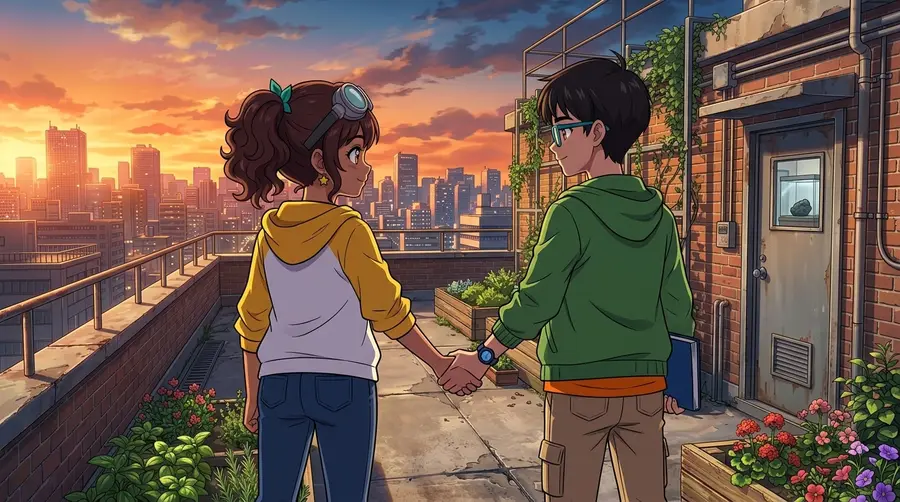
Panel 1 (full-width, top of page). Establishing shot of the rooftop at sunset. Aya sits at the edge, back to camera, hair moving in wind. SFX (faint, top corner): KAZE — wind CAPTION (Aya's thought): I had to tell him today.
Panel 2 (right-center, half-page wide). Close-up of Aya's hands gripping her phone. Screen shows an unsent text. Dialogue: (silence — no balloon)
Panel 3 (left-center). Yuto's foot stepping onto rooftop, off-panel above. SFX: GACHA — door handle
Panel 4 (right-bottom, small). Aya's eyes wide, looking up. (Silence, beat panel)
Panel 5 (left-bottom, large). Yuto stands in mid-ground, hands in pockets, looking at Aya. Wind moves his coat. Yuto: "You forgot your scarf."
That's it. Four to ten lines per panel. Five panels per page. Clean and reproducible.
Manga Script vs Comic Book Script — Side by Side
Same scene, two formats. Western full-script: "PANEL 1: Rooftop at sunset. Aya sits at the edge, looking out over the city. Wind moves her hair. Wide shot, establishing. CAPTION: 'I had to tell him today.'" Manga script: "Page 7, Panel 1 (top, full-width, right-to-left). Rooftop establishing, sunset, Aya back-to-camera. SFX: KAZE." Same information; the manga version specifies panel direction and SFX as integrated lettering. The Western version trusts the artist to interpret silence; the manga version names it.
Use an AI Tool for the First Draft
Modern AI comic tools can take a one-paragraph premise and output a paneled script in manga or comic format with SFX, dialogue, and shot types pre-filled. Use one to draft Page 1, then edit by hand. The AI is a fast scaffold for the boring parts — panel count budget, balloon placement, basic blocking — so you can spend your time on what makes the script yours: the dialogue, the page-turn moments, the SFX choices.