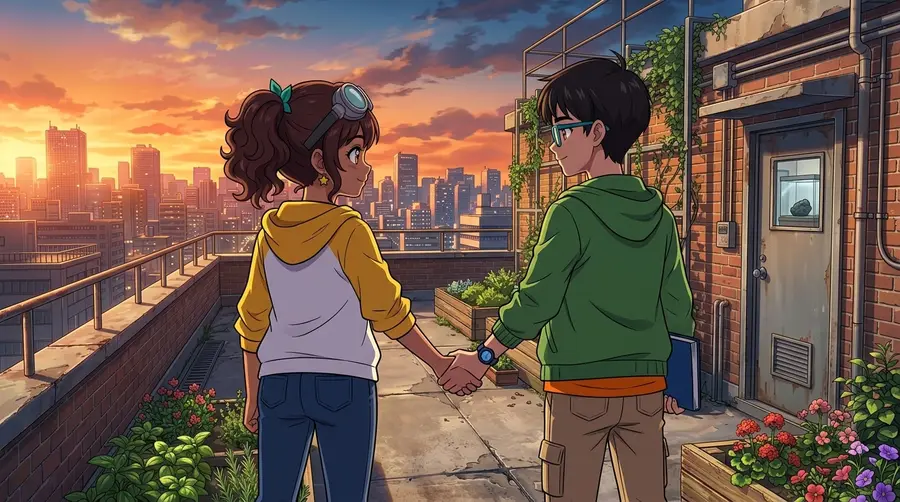
Start by Picking a Demographic
Japanese manga publishing is built around demographics — the target reader's age and gender shapes which magazine the manga runs in, which conventions the art follows, and which themes the editor will accept. Picking your demographic first is non-negotiable because every other decision downstream depends on it. A shonen battle manga and a josei romance manga are made by different rules in nearly every dimension — panel density, dialogue style, character age, even font weight in the sound effects. There are six broad demographic categories in Japanese publishing tradition; in practice most beginners will pick one of three.
Shonen — boys ages 10–18
The largest category by sales. Fast-paced action, friendship arcs, escalating stakes, training sequences. Page-dense panels with motion lines. Examples: Demon Slayer, My Hero Academia, Jujutsu Kaisen. The default starting point for beginners because the conventions are widely understood.
Shojo — girls ages 10–18
Romance-leaning, emotion-forward, character-driven. Soft linework, sparse panels with lots of white space, screentone gradients for mood. Examples: Fruits Basket, Sailor Moon. Strong template for slice-of-life and coming-of-age stories.
Seinen — adult men 18+
Denser narratives, moral ambiguity, mature themes. Realistic art, varied panel density, often longer chapter lengths. Examples: Berserk, Vagabond, Vinland Saga. We have a dedicated guide on the shonen-vs-seinen distinction linked at the end of this post.
Write the Story for Manga Pacing
Manga is page-based. Every reveal is a page turn; every beat is a panel. A manga script does not look like a screenplay or a novel — it is a list of panel descriptions grouped by page, with the dialogue attached to each panel. Before you draw anything, you write a full script for the chapter — typically 18–20 pages for a serialized chapter, 5–10 for a one-shot. Read mangaka interviews and you will hear the same thing: the script (a.k.a. "name" or ネーム) is the comic. Once the name works, drawing is execution.
Right-to-Left Reading
Japanese manga reads right-to-left across the page and within each row of panels. This shapes composition: the focal point of an opening panel sits on the right; the climactic panel of a page sits in the bottom-left. English releases either mirror the entire book or read in original direction; consistency matters more than which choice you make.
Page-Turn Reveals
The last panel of a left page is the cliffhanger; the first panel of the next right page is the payoff. Manga script structure exploits this everywhere — a reveal lands on a fresh page turn, not mid-spread. Pages 2 and 3 sit side-by-side, so a big reveal across a spread is a two-page splash.
Aspect-to-Aspect Pacing
Manga uses aspect-to-aspect panel transitions far more than Western comics — multiple panels of the same moment from different angles, building atmosphere before action. A rain scene might run four panels: a window, a puddle, a hand on a sill, a face. Mood first, plot second.
Cast Your Characters in Manga Style
Manga character design is dictated by demographic. Shonen heroes have spiky hair, sharp jawlines, and distinctive scars or color accents. Shojo leads have softer features, flowing hair, and large highly-detailed eyes. Seinen characters have realistic proportions and weathered faces. Pick the demographic conventions deliberately — readers expect them, and breaking them works only if it is the point of your story.
Build a Model Sheet First
Before drawing any page, draw your protagonist from five angles — front, three-quarter left, three-quarter right, side, back — plus expressions for joy, anger, fear, sorrow, and surprise. This becomes the model sheet you reference for every subsequent panel. Without it, the character's face drifts visibly across chapters.
Distinct Silhouettes
Every main character should be identifiable as a black silhouette. Different hair shapes, different body proportions, one signature visual element each. Manga uses extreme stylization — wild hair colors, eyepatches, scars — to keep silhouettes legible at the small panel sizes the format demands.
Use AI to Lock the Cast
Modern AI tools like Comicory's character creator solve the consistency problem by generating a reference portrait once and conditioning every subsequent panel on that reference. The character's face, hair, and outfit stay identical across hundreds of panels — the single biggest production headache, gone.
Drawing the Hard Parts
Once the script is solid and the cast is locked, the remaining task is the drawing itself. Four sub-skills carry most of the weight in manga: eyes, hair, mouths, and hands. The first three define the character's face — the part the reader looks at most. Hands are technically the hardest part of human anatomy and the part beginners avoid most often, which is why so many beginner manga panels hide hands behind sleeves or off-panel.
Eyes — The Manga Signature
Manga eyes carry most of the emotional load. Build the eye from three components: the upper lid (a single bold curve), the iris (large, taking up 60–80% of the visible eye), and the lower lid (often a faint curve). Highlights — small white reflective shapes inside the iris — sell the emotion. Shojo eyes are larger and more detailed; shonen eyes are sharper with less interior detail.
Hair — Shape, Not Strands
Manga hair is drawn as shapes, not individual strands. Block in the overall silhouette (the haircut), then divide into 3–5 major chunks, then add interior lines only where the shape bends. Spiky shonen hair, layered shojo hair, slicked-back seinen hair — each is a different chunk strategy. Avoid drawing individual hairs; the eye reads chunks faster than detail.
Mouths — Simple, Expressive
Manga mouths are minimal in a relaxed face — often a single line. Open mouths use 2–3 curves: upper lip, lower lip, optional teeth indication. Emotion comes from the corners — pulled up for joy, pulled down for sadness, pulled sideways for embarrassment. Resist the urge to add lip detail; it makes the face read older and more realistic, which is fine for seinen but wrong for shonen and shojo.
Hands — Build From Shapes
Most beginner panels avoid hands. Build hands from a flat square palm plus four finger cylinders plus a thumb. Practice the five base poses: open palm, fist, pointing, gripping, relaxed. Most expressive hand poses are variations on these five. AI tools have improved dramatically at hands in 2025–2026 but still struggle with extreme gestures; review and regenerate any panel where the hands look off.
Lay Out the Page
Manga page layout has its own grammar. A standard manga page runs 6–8 panels with variable sizes — a 2×3 grid is a starting point, but most working pages break the grid for emphasis. The biggest panel on a page is the page's main beat. Use the Comicory manga panel generator to render variable layouts without redoing the underlying art each time you re-paginate.
Z-Pattern Reading
The reader's eye traces a Z across each page — starting top-right, ending bottom-left (in right-to-left manga). Layout panels so the eye flows naturally along this Z. Bad layouts create reading ambiguity — readers don't know whether to read across or down.
Variable Panel Sizes
The biggest panel anchors the page. A small panel reads fast; a large panel reads slow. Match the panel size to the beat's importance. A reaction shot can be a tiny half-row panel; a hero's reveal deserves a full-width splash.
Screentone vs Color
Traditional manga is black and white with screentone (regular dot patterns) for shading and texture. Color is reserved for cover pages and chapter openings. Webtoon-style color manga is a different tradition. Pick a lane and commit — switching mid-series confuses readers.
The AI Shortcut
A first manga chapter takes most beginners 200–500 hours of work, spread across months. Modern AI tools collapse most of that to a single afternoon. The Comicory manga generator takes a one-sentence premise, expands it into a paneled script in the right pacing for your chosen demographic, renders every panel with character consistency locked, and exports a print-ready chapter. The first chapter that used to take months now takes under an hour. Skill-building is no longer the gate; storytelling is. Whether you eventually transition to drawing your own panels is your call — many indie creators use AI for the production scaffolding and then redraw key panels by hand for the chapters they care about most.
Common Mistakes Beginners Make
Five patterns trip up first-time manga creators. Avoid them and your first chapter immediately reads more native to the format.
Writing Like a Novel
Prose paragraphs do not translate to panels. Write a panel-by-panel script with explicit panel numbers, descriptions, and dialogue. If you cannot picture the panel from the description, the description is wrong.
Skipping the Model Sheet
Without a model sheet (or AI character reference), your protagonist's face drifts visibly across chapters. The reader notices on chapter 2 even if they cannot articulate why. Lock the cast before drawing.
Ignoring the Demographic
Trying to write a manga without picking a demographic produces something that reads as neither. Pick shonen, shojo, or seinen at the start and follow its conventions deliberately. You can subvert conventions later; first, internalize them.
Color From Day One
Traditional manga is black-and-white. Beginners often start in color because it looks more polished, then burn out on the production load. Start black-and-white with screentone — it is the format's native voice and one-third the production time.
Trying to Draw the Whole Chapter Before Writing It
The temptation is to draw a pretty splash page first, then figure out the chapter around it. This is how most beginner manga die. Write the full chapter script first; draw second. Drawing without a script wastes time and produces incoherent work.